SBC-LT Series Carrier

Zero-force temporary bonding and debonding for semiconductor and advanced packaging. Delivered fully prepared, no capital equipment required.

Mobile Temporary Bonding & Debonding Carrier

The SBC-LT Series Carrier is Semi-Bond's mobile temporary bonding solution for semiconductor backgrinding, advanced packaging, and related processes. Carriers are delivered fully prepared for immediate use — no spin coat, bake, or cure of bonding material required.

Carrier size and shape is customizable to meet customer needs, available in standard wafer diameters as well as customer-defined geometries.

What the SBC-LT Is Designed For

  • Thin wafer handling
  • Chip and chiplet handling
  • Fragile material and device handling
  • Semiconductor and advanced packaging processes
  • Adapter carriers for uniform wafer processing sizes
  • National laboratory, university, and government-funded advanced packaging and heterogeneous integration research

How It Works

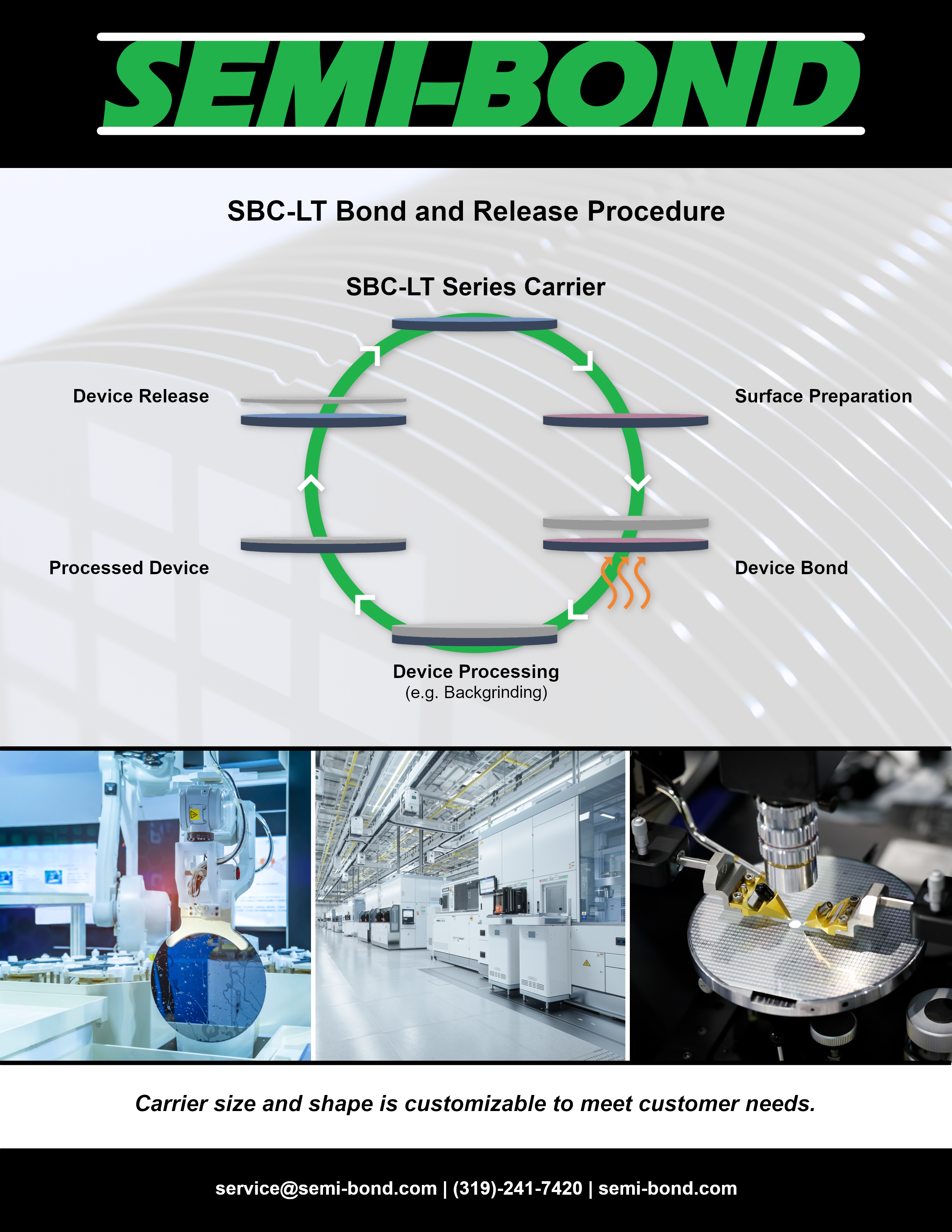
The SBC-LT process integrates into existing workflows in five steps, with zero-force bond and debond at every stage.

Step 1 Surface Preparation

Prepare the device surface for bonding

Step 2 Device Bond

Zero-force bond to the SBC-LT carrier

Step 3 Device Processing

e.g. backgrinding, wet/dry processes

Step 4 Processed Device

Device remains securely bonded throughout

Step 5 Device Release

Zero-force release — no thermal, laser, or cleaning step

Benefits of the SBC-LT Series Carriers

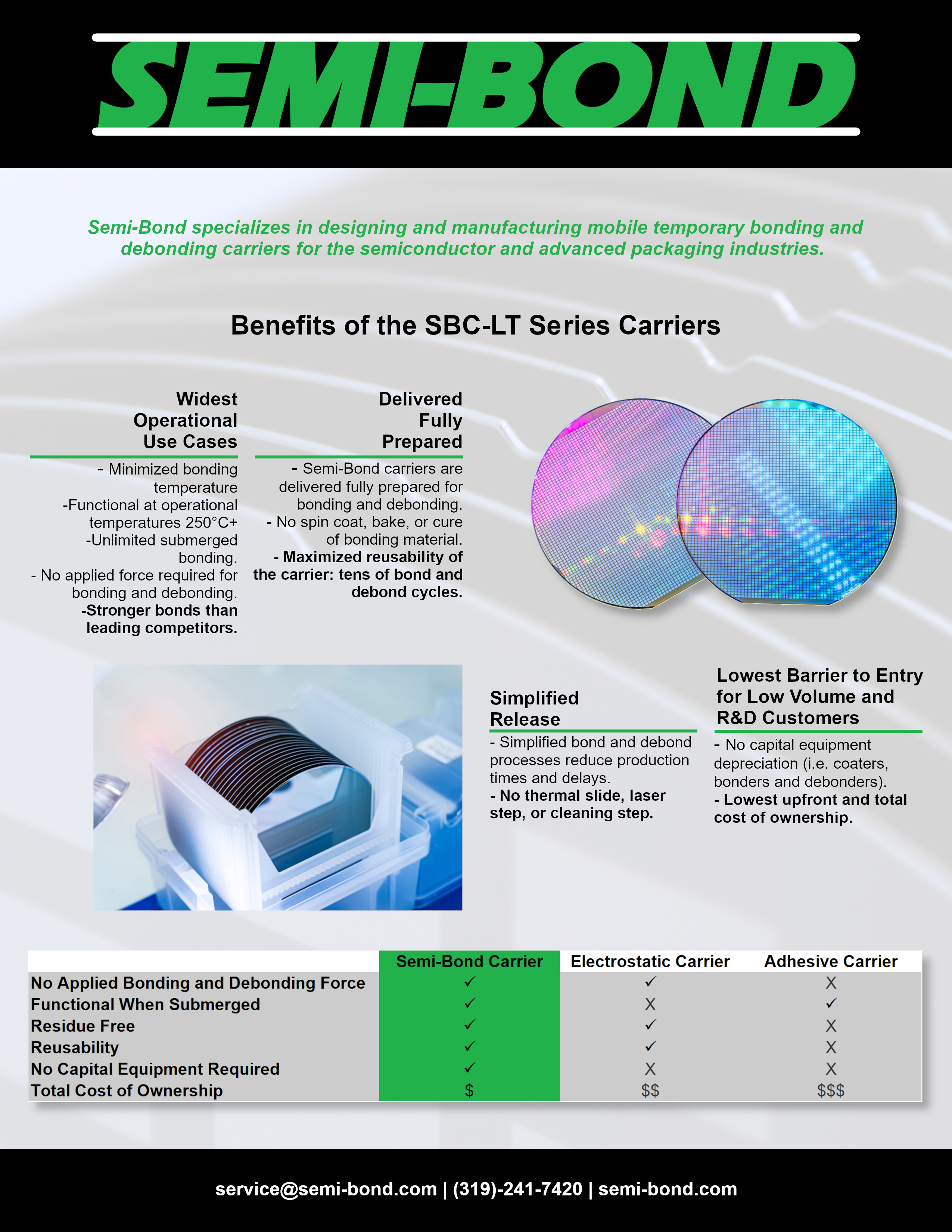
Widest Operational Use Cases

  • Minimized bonding temperature
  • Functional at operational temperatures of 250°C and above
  • Unlimited submerged bonding capability
  • No applied force required for bonding and debonding
  • Stronger bonds than leading competitors

Delivered Fully Prepared

  • Carriers arrive ready for bonding and debonding — no preparation needed
  • No spin coat, bake, or cure of bonding material
  • Maximized reusability: tens of bond and debond cycles per carrier

Simplified Release

  • Simplified bond and debond processes reduce production times and delays
  • No thermal slide, laser step, or cleaning step required

Lowest Barrier to Entry

  • No capital equipment depreciation — no coaters, bonders, or debonders needed
  • Lowest upfront and total cost of ownership
  • Ideal for low-volume production, R&D programs, and university cleanrooms where dedicated bonding tools aren't available or practical to qualify
  • No minimum order volume — works for single-experiment runs as easily as production

SBC-LT vs. Electrostatic & Adhesive Carriers

The SBC-LT Series Carrier outperforms competing temporary bonding technologies across every key metric.

Electrostatic Carrier Limitations

  • Rapid bond degradation when submerged, such as when backgrinding
  • Bond strength degrades at elevated temperatures, risking device damage and electrostatic discharge events
  • Requires ultra-clean, ultra-flat surfaces to function reliably
  • Relatively weak bonds make holding small devices like chiplets difficult
  • Damaged dielectric layers cause inconsistent performance and latent bond degradation

Adhesive Carrier Limitations

  • Adhesive residue left on devices requires cleaning after debonding
  • Limited upper operating temperature
  • Requires compressive force and high bonding temperatures
  • Release mechanisms introduce mechanical or thermal stress to devices

The SBC-LT addresses all of these:

  • Rated for 250°C and above with no bond degradation from temperature fluctuations
  • Works in submerged environments such as backgrinding and wet thinning processes
  • Zero-force bond and debond minimizes device damage risk
  • Strong, consistent bonds that reliably hold small devices and chiplets
  • Bonds to almost any material, including non-smooth and non-flat surfaces
  • No residue or FOD after debonding. No post-process cleaning required
  • Rugged construction resistant to the layer damage that degrades electrostatic carriers
  • Bonds at lower temperatures than adhesive carriers
Feature Semi-Bond Carrier Electrostatic Carrier Adhesive Carrier
No Applied Bonding and Debonding Force
Functional When Submerged
Residue Free
Reusability
No Capital Equipment Required
Total Cost of Ownership $ $$ $$$

SBC-LT Series Carrier Brochure

SBC-LT Series Carrier brochure page 1 — bond and release procedure diagram showing surface preparation, device bond, backgrinding, and device release steps SBC-LT Series Carrier brochure page 2 — benefits overview including widest operational use cases, delivered fully prepared, simplified release, and competitive comparison table

Request SBC-LT Series Carrier Information

Contact us to discuss your backgrinding, advanced packaging, or other temporary bonding requirements. Custom sizes and shapes available.

Contact Us